


For 46 years, Africa has been absent from the Formula 1 grid.
That absence has never reflected a lack of talent. It has reflected something far more difficult to overcome: access, infrastructure, cost, and the absence of a clear development pathway for young drivers with world-class potential.
Now, a South African motorsport initiative is working to change that.
Through a structured, long-term vision for driver development, WORR Motorsport is building what it believes could become Africa’s most credible route from grassroots karting to the international single-seater ladder. At the centre of that vision is the belief that African drivers do not need to wait for opportunity abroad; they need a system at homeserious enough to prepare them for the world stage.
And for the people behind this mission, this is far more than a business plan. It is personal.
Why Africa has been missing from Formula 1
The last African driver to compete in Formula 1 was Jody Scheckter, South Africa’s 1979 world champion, who retired after the 1980 Italian Grand Prix. Since then, Formula 1 has crowned champions from Europe, South America and beyond, while Africa, home to more than 1.4 billion people and a deeply competitive sporting culture, has remained absent.
According to Wesleigh Orr, founder of WORR Motorsport, that gap has never been about raw ability.
Instead, he argues, African motorsport has long lacked a credible system that can identify talented young drivers early, support their growth, and guide them through the notoriously demanding steps required to reach elite international racing.
That is the gap WORR Motorsport wants to fill.

Building a real pathway, not just a dream
WORR Motorsport’s vision is ambitious but practical. Rather than relying on isolated success stories or hoping a single driver breaks through, the organisation is trying to create a sustainable structure that can repeatedly produce talent.
Its focus begins where so many racing careers begin: karting.
Karting remains the global foundation of driver development, but across Africa it has often been prohibitively expensive. Competitive equipment is usually imported, and the costs attached to importing high-quality karts place the sport out of reach for many families.
To tackle that barrier, WORR Motorsport has entered into a manufacturing partnership with TB Kart, one of the world’s leading karting manufacturers, to produce karts on the African continent. The result is more than symbolic. It is already making a measurable difference.
According to the organisation, kart costs are currently 20 to 30 percent lower than standard import pricing through this partnership, with a five-year target of reducing prices by up to 55 percent while maintaining the same competitive standards used internationally.
That matters enormously. In motorsport, the cost of entry often determines who gets to begin, long before talent has the chance to speak for itself.
As Orr puts it, Africa has never lacked gifted drivers. What it has lacked is a workable system that allows those drivers to progress. Lowering the barrier to entry is therefore not a side issue, it is the starting point.
Creating access at every level of the sport
The organisation has also been appointed the official Pan-African distributor for TB Kart’s rental kart range, a move that will help expand access to karting facilities and venues across the continent.
This is a crucial part of the bigger picture.
Not every future racing star begins in a fully funded competitive karting environment. Many first discover the sport through rental karts, fun runs, local tracks and casual exposure. By improving access at that level, WORR Motorsport hopes to widen the talent pool dramatically and create a more inclusive starting point for young African drivers.
The goal is clear: reduce the expense of the sport at every stage, from a child’s first karting experience to their first serious competitive season.
Early signs that the model is working
Although the long-term ambition is to place African drivers on the Formula 1 ladder, WORR Motorsport says the system is already delivering results.
Its academy currently has 15 drivers preparing to compete in the coming weeks, while alumni are racing for professional teams in Europe and Asia. Drivers developed through the programme have also secured victories in competitions including the ROK Cup, the Rotax Max Challenge, and other FIA-sanctioned karting categories.
Those results matter because they show that when African drivers are given the right coaching, structure and support, they can compete with the best.
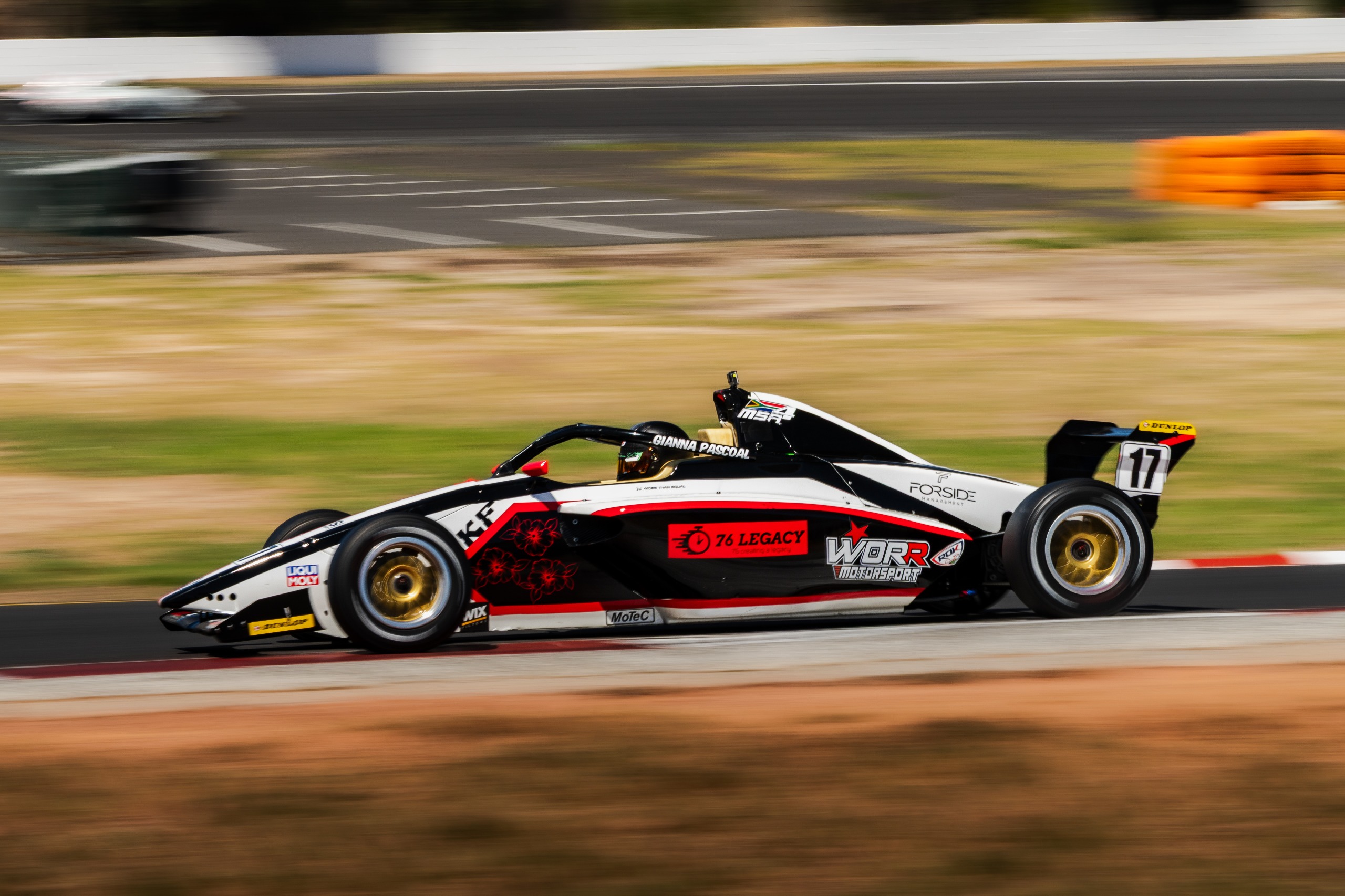
A particularly significant milestone will arrive in 2026, when Gianna Pascoal becomes Africa’s first female driver to compete in Formula 4 through the WORR development pipeline. Her move onto the Formula 4 grid marks an important step not only for the programme but also for representation in African motorsport.
For a continent working to build its way back into the highest levels of racing, that moment carries real weight.
Taking African motorsport beyond South Africa
The project is no longer limited to South Africa.
A fully operational karting hub in Rwanda is already confirmed for launch within the next 12 months, becoming the second centre in what WORR Motorsport intends to grow into a continent-wide network of development hubs.
The thinking behind these hubs is especially important. For too long, many drivers with serious ambitions have felt compelled to relocate to Europe early in order to access better competition, training and technical support. WORR Motorsport wants to challenge that assumption by developing more of that ecosystem within Africa itself.
Each hub is intended to provide coaching, competitive programmes, technical development, and mentorship, allowing young drivers to grow in a high-performance environment closer to home. The vision also stretches beyond drivers. Professional motorsport depends on a much broader network of talent, and these hubs are designed to help develop engineers, mechanics, data analysts, and team managers too.
That kind of ecosystem-building is what turns isolated promise into a functioning industry.
A wider cultural shift for African motorsport
As part of its expansion strategy, WORR Motorsport also owns Karting Africa, a platform dedicated to growing grassroots participation and competitive karting throughout the continent.
One of its most visible upcoming moments will be the Karting Africa Ghana Showrun 2026, scheduled for May and formally endorsed by Ghana’s National Sporting Authority. The event is expected to attract up to 40,000 attendees, which reflects something bigger than a race weekend: a growing appetite for motorsport on the continent.
Momentum is also being recognised at an institutional level.
Rodrigo Rocha, FIA Vice-President for Sports (Africa), has publicly aligned himself with WORR Motorsport’s programme — a meaningful endorsement from the governing body that oversees Formula 1 and virtually every major international motorsport series.
That level of backing matters. It suggests that the effort is being taken seriously not only as a local initiative, but as part of the global conversation about the future of the sport.
More than a comeback story
What makes this story compelling is that it is not just about getting an African driver back onto the Formula 1 grid one day. It is about rebuilding the missing steps in between.
It is about making motorsport more accessible. It is about creating systems rather than relying on luck. It is about ensuring that young African talent no longer has to depend solely on extraordinary personal sacrifice to be seen.
And it is about learning from past generations.
My personal connection to racing
Long-time readers of this site know that I’m fortunate enough to know Grant Orbell, who had great potential to get onto the F1 grid.
His journey remains a powerful reminder that talent alone has never guaranteed progression in motorsport. Even with championship-winning results, international experience, a Le Mans appearance, and a Jordan F1 test in the late 1990s, the road upward was shaped by financial reality as much as by performance.
Grant started karting in 1989 at the age of 11 (the same age Gianna Pascoal started karting), before moving into circuit car racing in 1994. Just a year later, he won the sports car championship in 1995, establishing himself as a standout young talent. He then rose quickly through the ranks of Formula Ford, finishing second in the championship in 1996 and winning it in 1997, only his second season in the category. That same year, he also represented South Africa in the Formula Ford World Finals.
His career continued to gather momentum internationally. In 1998, he began racing world sports cars, and in 1999 he competed in the legendary 24 Hours of Le Mans, one of the most respected endurance races in global motorsport. That year marked his final full season of international competition.
In the late 1990s, he also tested for Eddie Jordan’s Jordan Formula 1 team, a milestone that placed him within touching distance of Formula 1 machinery and underscored the level at which he was operating. But, like many talented South African drivers before and after him, he came up against the financial realities of the sport. With the enormous funding demands of top-level motorsport and too little meaningful corporate sponsorship available to South African drivers, he made the difficult decision to focus on the racing trajectory already in front of him.
In 2000, he earned his Protea Colours for Motorsport, a fitting recognition of a career that remains an important part of South African racing history. And for those visiting Zwartkops Raceway, his name still stands proudly on the Wall of Fame: Chevron B16 Champion.


0 Comments