


There is something very South African about a good road trip. The snack stop. The padstal coffee. The quick stretch. The debate over whether Harrismith is “almost there” or absolutely not. For years, the Johannesburg-to-Durban route has been powered by petrol pumps, diesel tanks, and the occasional “is this the right exit?” moment. Now, a new kind of stop is joining the journey: off-grid, solar-powered electric vehicle charging.
Zero Carbon Charge, known as CHARGE, has launched two new off-grid EV charging stations along the N3 corridor between Johannesburg and Durban. It is a big deal, not only for electric car owners, but also for freight operators, logistics companies, and anyone watching South Africa’s transport future start to shift from fuel tanks to batteries.
The first site, CHARGE N3 Roadside, is located at the Reitz Interchange, Exit 107, in the Free State. The second site, CHARGE N3 Tugela, is located at the Colenso-Winterton Interchange, Exit 207, in KwaZulu-Natal. Together, they mark the beginning of South Africa’s first off-grid EV charging network on the N3 corridor, one of the country’s most important transport and freight routes.
And here is the clever part: these stations are not waiting politely for the national grid to behave. They generate clean solar energy on-site, store it in batteries, and deliver reliable off-grid charging for electric vehicles, including commercial vehicles and trucks.
Why the N3 Matters So Much
The N3 is not just a road. It is one of South Africa’s major economic arteries.
It connects Gauteng, the country’s commercial engine room, with KwaZulu-Natal and the Port of Durban. Every day, passenger vehicles, delivery vans, long-haul trucks and logistics fleets move along this route carrying people, goods, groceries, building materials, business stock, and almost everything else that keeps the economy ticking.
So, when CHARGE electric vehicle charging infrastructure lands on the N3, it is not just about making weekend trips easier for EV drivers. It is about preparing a key freight corridor for the next generation of transport.
For passenger EV owners, this means more confidence to travel longer distances without range anxiety. For fleet operators, it introduces the possibility of cleaner, more predictable transport energy costs. For South Africa, it is another step towards reducing reliance on imported liquid fuels and building a more resilient transport system powered by locally generated renewable energy.
Off-Grid Charging: The Bit That Makes This Different
Most people think of EV charging as something plugged into the grid. That makes sense in many countries where electricity supply is stable, predictable and plentiful. South Africa, however, has had to become rather creative about energy. We know the grid has limits. We also know the sun is not exactly shy around here.
CHARGE’s model uses solar-powered microgrids and battery storage to operate independently from the national electricity grid. In plain English: the station makes its own power, stores that power, and uses it to charge vehicles.
That is a big advantage in a country where transport electrification cannot depend only on grid expansion. Off-grid charging allows infrastructure to be placed along strategic routes where it is needed most, without waiting for major grid upgrades in every location.
It also means the electricity being used is renewable. So the environmental benefit of driving electric is strengthened because the charging energy is generated from solar power rather than fossil-fuel-heavy electricity supply.
Built for Cars, But Thinking Bigger Than Cars
The launch is exciting for private EV drivers, but the long-term story is much bigger. CHARGE is building infrastructure that can support electric freight mobility too.
This matters because trucks are a major part of South Africa’s transport emissions profile. Long-haul freight is also deeply exposed to changing diesel prices. When fuel costs spike, logistics costs rise, and those increases often filter through to the price of goods. Nobody loves discovering that their groceries, building supplies, or deliveries now come with a hidden fuel-price hangover.
By creating reliable charging points on major freight routes, CHARGE is helping remove one of the biggest barriers to electric truck adoption: infrastructure confidence.
Fleet operators do not just need chargers. They need chargers in the right places, with enough capacity, high uptime, useful amenities, and predictable access. The N3 rollout is a strong signal that electric mobility in South Africa is moving beyond the city commute and into the world of commercial transport.
What Drivers Can Expect at the New N3 Stations
The two new N3 sites have been designed to make charging feel less like a technical stop and more like a proper travel break. Each station can charge up to eight EVs at the same time, using three DC chargers with six dispensers, plus two AC chargers with one dispenser each.
The DC fast chargers are designed to allow most EVs currently available in South Africa to charge close to their maximum supported power. Charging time will depend on the vehicle, battery size and battery configuration, but a typical EV can charge from 20% to 80% in around half an hour.

That is basically enough time to grab a coffee, visit the restroom, stretch your legs, check your messages, negotiate with yourself about buying padkos you absolutely did not need, and get back on the road.
Payment and charging are handled through the CHARGE mobile app, creating a smoother user experience. Both sites also offer complimentary WiFi, restrooms, and on-site farm stalls. The Free State site is paired with Leeukop Padstal, while the KwaZulu-Natal site includes Three Towers Farm Stall.
This matters more than it sounds. Good charging infrastructure is not only about kilowatts. It is about the full stop. Drivers need somewhere safe, comfortable, and useful to spend that charging time. A well-placed charger next to a good farm stall? That is how EV travel starts feeling normal.
More Charging Capacity Than the Pilot Site
CHARGE’s first pilot site, CHARGE N12 Wolmaransstad in the North West, launched in November 2024 and has achieved 99% uptime. That is important because reliability is one of the first questions people ask about EV charging.
The new N3 stations build on that pilot model, but with 50% more charging capacity. In practical terms, this means the N3 sites are designed for greater demand, faster throughput, and broader vehicle use. They are not experimental showpieces tucked away for the photo opportunity. They are working infrastructure placed on a major route where charging demand is expected to grow.
Even better, the two stations were delivered in under five months and on target. That speed matters because South Africa cannot afford a slow-motion infrastructure rollout if EV adoption continues to accelerate.
Backed by DBSA: Why the Funding Matters
The N3 expansion is supported by a R100 million investment from the Development Bank of Southern Africa, better known as DBSA.
That backing gives the project more than financial muscle. It also signals institutional confidence in renewable energy-powered transport infrastructure. When a development finance institution supports a project like this, it helps validate the idea that clean mobility is not a niche luxury project. It is infrastructure. It belongs in the same conversation as roads, logistics, energy security and economic growth.
CHARGE’s model sits neatly at the intersection of several national priorities: cleaner transport, decentralised energy generation, reduced carbon emissions, support for logistics resilience, and greater energy independence.
Why EV Charging Is Starting to Feel Less “Future” and More “Now”
For a long time, electric vehicles in South Africa were treated like something from the next chapter. Interesting, yes. Coming eventually, probably. Relevant to everyday life? Not quite yet.
That is changing.
Recent AutoTrader data shows that EV searches in South Africa increased by 45% year-on-year between February and March 2026, while engagement rose by more than 200%. In March alone, South Africa recorded a record 389 EV sales, helped by more affordable models entering the market.
Those numbers show something important: people are no longer just vaguely curious. They are comparing, clicking, asking questions, and buying.
Infrastructure has to keep up with that interest. More EVs on the road means more demand for reliable public charging, especially beyond city centres. The arrival of CHARGE electric vehicle charging stations on the N3 helps close that gap by giving drivers and fleet owners more confidence to travel and operate across longer distances.
The Padstal Era of EV Charging Has Begun
One of the most charming parts of this launch is the setting. EV charging could easily feel sterile and overly technical. But placing stations alongside farm stalls gives the whole thing a very South African personality.
Instead of standing awkwardly next to a charger wondering what to do with yourself, travellers can pop into a padstal, get something to eat, use the restroom, and enjoy a proper break. It turns charging from a waiting period into part of the journey.

This is exactly the kind of thinking that helps normalise EV travel. People do not want infrastructure that feels like homework. They want a stop that fits naturally into how they already travel.
In that sense, CHARGE is not just installing chargers. It is designing roadside behaviour for the electric age.
Why Off-Grid Charging Helps Reduce Range Anxiety
Range anxiety is one of the biggest psychological hurdles for EV adoption. Even when modern EVs offer practical driving ranges, drivers still want reassurance that they can charge where and when they need to.
That anxiety becomes more intense on long-distance routes. City driving is one thing. A long N3 trip between Johannesburg and Durban is another. Nobody wants to spend half the journey doing maths with battery percentages.
By placing off-grid charging stations along a key national corridor, CHARGE is helping turn EV travel into something more predictable. Drivers can plan around real charging stops. Fleet operators can build route models with more confidence. And because the stations are powered by solar microgrids rather than relying entirely on grid availability, they add another layer of energy resilience.
A New Energy Model for Transport
The bigger story behind CHARGE electric vehicle charging is not simply that EVs need places to plug in. It is that South Africa has an opportunity to rethink how transport energy is produced and supplied.
For decades, mobility has been tied to imported liquid fuels. That creates exposure to global oil prices, currency fluctuations, refinery constraints, and supply chain shocks. When fuel prices rise, South Africans feel it everywhere, from transport fares to food prices.
Electric mobility opens a different path. If vehicles can be powered by locally generated renewable energy, the country gains more control over transport energy costs and supply resilience.
CHARGE’s off-grid model is especially interesting because it decentralises energy generation. Instead of relying solely on large centralised systems, each station becomes its own clean energy node. Over time, a national network of these stations could help create a more distributed, resilient and cost-stable mobility ecosystem.
What Comes Next for CHARGE
The N3 launch is part of a much larger rollout plan. After the N3 corridor, CHARGE plans to move into its next major phase along the N1 corridor. From there, the company aims to expand with 60 additional sites before densifying the network to complete a full 120-site national charging footprint.
That kind of coverage would be a major step forward for South African EV adoption. Public charging availability is one of the biggest practical factors shaping buyer confidence. The more visible and reliable the network becomes, the easier it is for individuals and businesses to make the switch.
For commercial fleets, network coverage will be especially important. Electric trucks and delivery vehicles need route certainty, downtime planning and access to charging infrastructure that can handle real operational demand.
Why This Launch Is Bigger Than Two Charging Stations
It would be easy to look at the launch and say: two new EV charging stations opened on the N3. Nice. Moving on.
But that misses the point.
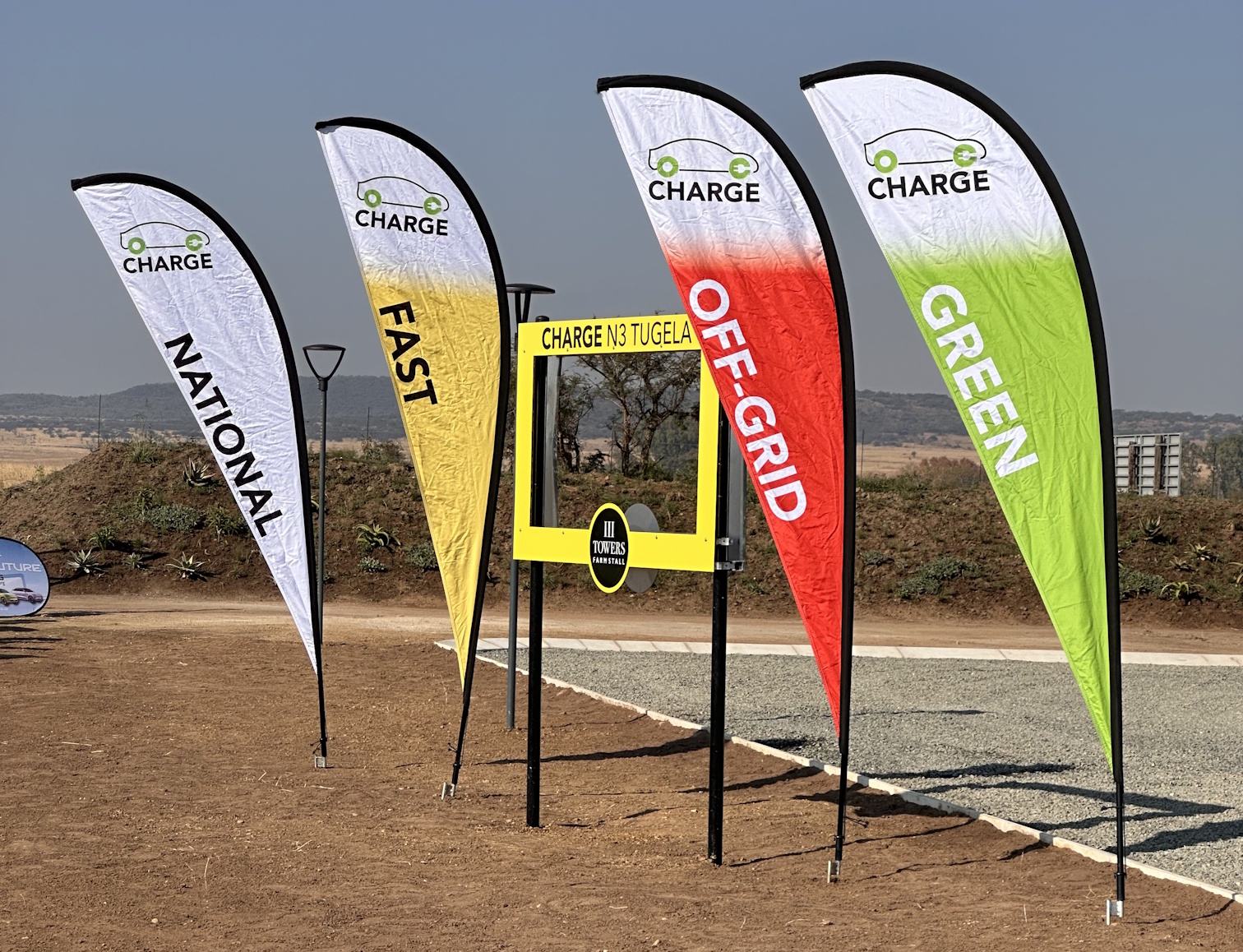
These sites represent a shift in how South Africa can think about mobility infrastructure. They show that EV charging can be built off-grid. They show that solar-powered transport energy can work on strategic corridors. They show that public and private sector investment can support scalable clean mobility. And they show that South Africa does not have to wait passively for the future of transport to arrive from somewhere else.
It can build that future locally, with local sunlight, local infrastructure and local routes in mind.
CHARGE Electric Vehicle Charging and the Road Ahead
The launch of CHARGE’s off-grid charging stations on the N3 corridor is a strong sign that electric mobility in South Africa is becoming more practical, more visible and more ambitious.
For everyday drivers, it means long-distance EV travel is getting easier. For fleet operators, it means the infrastructure needed for electric freight is starting to take shape. For the broader economy, it points towards a transport system that is less exposed to volatile fuel prices and more connected to renewable energy.
And for anyone who loves a classic South African road trip, it means the future might look surprisingly familiar: a good route, a good stop, a decent coffee, a farm stall snack, and a vehicle quietly filling up on sunshine.
Only this time, the pump is a charger. The fuel is solar. And the road ahead looks a whole lot cleaner.


0 Comments