


Another audiobook review, thanks to NetGalley.
There are writing books that leave you with a notebook full of tips. Then there are writing books that make you want to abandon everything else you’re doing, open your laptop, and finally write the story that’s been rattling around in your head for years.
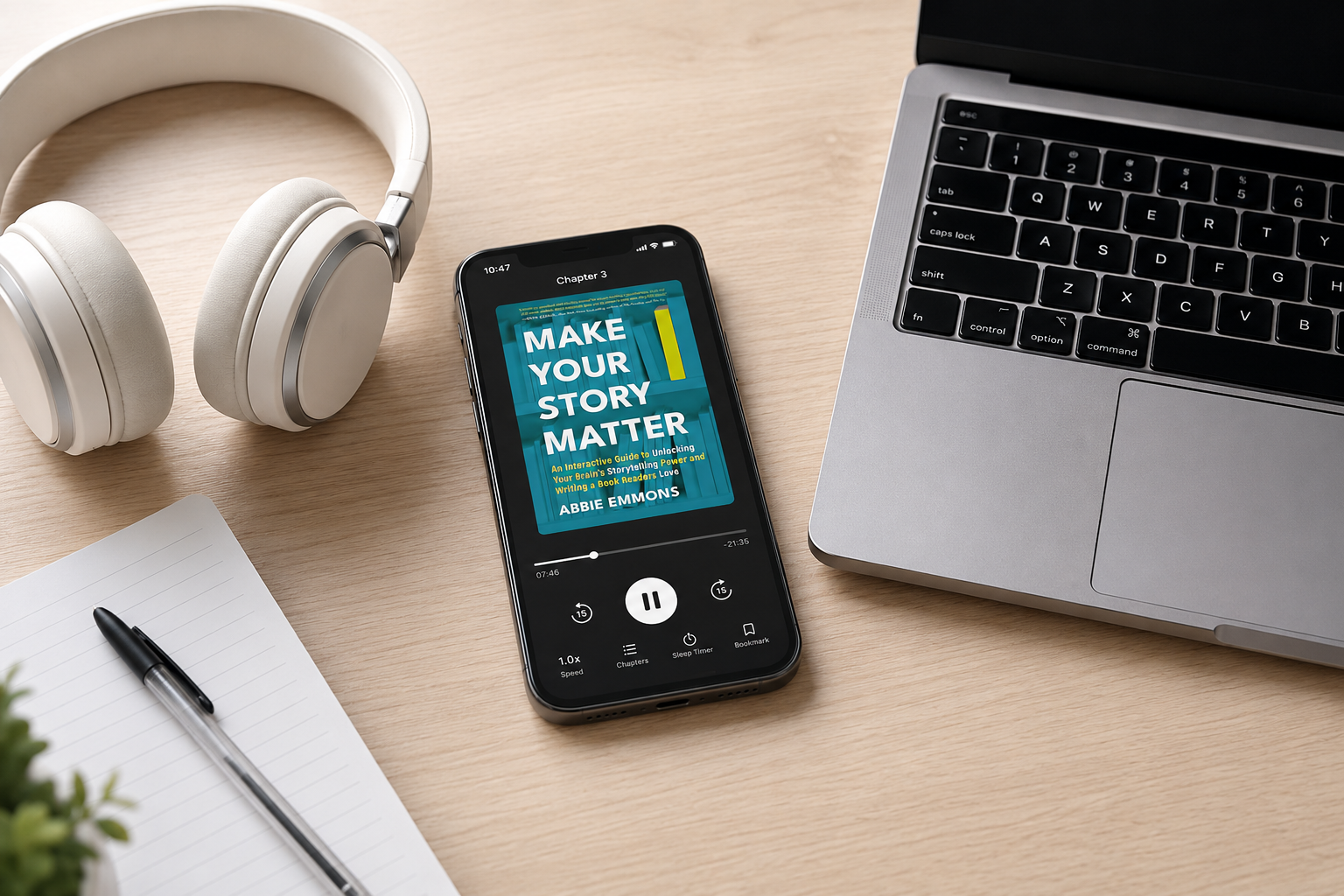
Make Your Story Matter by Abbie Emmons very firmly falls into the second category.
I absolutely loved this audiobook. More importantly, I finished it feeling genuinely excited about writing again, something I haven’t felt this strongly in years. And, for a book about creativity, storytelling, and finding your way back to the joy of writing, I can’t think of a better recommendation than that.
Writing Advice That Actually Feels Usable
One of the biggest problems with learning about writing is that there is simply so much advice.
Show, don’t tell. Except when you should tell.
Outline everything. Except when you absolutely shouldn’t.
Follow the rules. Break the rules. Write every day. Don’t force yourself to write every day.
Eventually, it can feel as though you need a postgraduate degree in conflicting opinions before you’re allowed to write Chapter One.
Abbie Emmons takes a refreshingly different approach. Rather than piling another collection of rigid storytelling commandments onto your already overloaded brain, Make Your Story Matter focuses on understanding why stories affect us in the first place.
Her approach combines storytelling techniques with psychology and brain science, but don’t let that description make you imagine something dry or academic. The concepts are explained in an accessible, conversational way, and everything comes back to one practical question: how do you create a story that genuinely makes readers care?
At the centre of the book is Emmons’ Who, What, Why Method, a straightforward three-step framework designed to help writers understand their characters, their stories, and the emotional reason behind everything that happens.
It sounds simple.
That’s largely the beauty of it.
Characters Before Complicated Plot Diagrams
One of my favourite things about Make Your Story Matter is its emphasis on emotional connection.
Instead of treating characters like little chess pieces you move around whenever your plot outline tells you to, Emmons encourages writers to dig into what their characters want, what they fear, what they believe, and why those things matter.
That naturally feeds into the plot.
It’s an approach that makes storytelling feel far less mechanical. You aren’t desperately trying to manufacture exciting events because page 73 of a writing manual says an inciting incident must occur at precisely the right percentage mark. You’re building events around characters whose choices, motivations, and emotional journeys actually mean something.
The result is advice that feels particularly useful if you’ve ever had a promising story idea but couldn’t quite figure out how to transform that idea into an entire novel.
You know the one.
Amazing opening scene. Interesting protagonist. Fabulous Pinterest board.
Absolutely no idea what happens for the remaining 80,000 words.
Make Your Story Matter helps bridge that gap.
Plenty of Practical Help
This isn’t simply a motivational audiobook telling you to believe in yourself and go write your masterpiece.
There’s plenty of practical guidance covering characters, plotting, story structure, voice, emotional impact, creativity, and burnout.
Emmons also provides templates and exercises that allow you to immediately put the ideas into practice rather than simply nodding enthusiastically while listening and then forgetting everything three hours later.
Even better, there is a free companion workbook available to download from Abbie Emmons’ website.
I love this.
The workbook makes the audiobook format particularly useful because you can listen to the concepts while working through the exercises separately. It turns the experience into something closer to a mini writing course than simply another book about writing.
And because the method is so easy to follow, I could immediately imagine returning to the exercises whenever I’m planning a new story or trying to untangle one that has gone spectacularly off the rails.
An Excellent Audiobook, and Now I Want the Book Too
Ironically, one of the strongest endorsements I can give the audiobook is that it made me want to buy the physical book.
Listening is fantastic for understanding the concepts and absorbing Emmons’ approach, but there is so much here that I know I’ll want to reference again.
Certain sections practically beg for sticky notes.
And highlighting.
Possibly colour-coded tabs.
I can absolutely see Make Your Story Matter becoming one of those permanently battered writing books that lives beside my computer and gets pulled down whenever a character refuses to cooperate or a plot develops an inconvenient hole large enough to swallow the entire third act.
So yes, despite already having listened to the audiobook, I’ll definitely be buying a physical copy.
The Best Thing It Gave Me Wasn’t a Writing Technique
There are loads of genuinely useful ideas in Make Your Story Matter, but the biggest thing I took away from it wasn’t a particular plotting method, character exercise, or storytelling technique.
It was enthusiasm.
Writing can become strangely intimidating once you’ve consumed enough advice about how you’re supposedly meant to do it. Something that began as creative play can gradually turn into an enormous checklist of things you’re terrified of doing incorrectly.
This book somehow strips away a lot of that noise.
By the end, I wasn’t thinking about all the ways a story could go wrong.
I was thinking about the story I wanted to write.
And I haven’t felt this inspired to write a book in years.
That alone makes Make Your Story Matter an easy recommendation.
Final Verdict
If you’ve got an idea you can’t quite turn into a novel, characters who feel a little flat, a plot that refuses to behave, or you’ve simply lost some of your enthusiasm for writing, Make Your Story Matter is well worth a listen.
Abbie Emmons takes potentially complicated storytelling concepts and makes them approachable, practical, and surprisingly energising. The Who, What, Why Method gives you something concrete to work with, while the companion workbook helps turn all that inspiration into actual writing.
It’s informative without feeling overwhelming, structured without being rigid, and encouraging without descending into empty motivational fluff.
Most importantly, it reminded me why I wanted to write stories in the first place.
I finished the audiobook inspired, excited, and already thinking about what I want to write next.
Some books earn a permanent spot on the writing shelf. I suspect this is going to be one of them.


0 Comments