


The McL 6GT explores a compelling idea: a supercar’s future can be shaped by how deeply it involves its driver. With V8 power, a manual transmission, and design rooted in Bruce McLaren’s M6GT, the concept brings an unfinished ambition into the present, placing mechanical connection at the centre of the story.
I love driving my manual transmission car, but while I’m still technically recovering from hip replacement surgery earlier this year, I can absolutely see the appeal of an automatic. There’s something revealing about a gearstick. It’s a small part of a car, but its presence changes what the driver is being invited to do. Reach across, choose a ratio, and take an active role in the rhythm of the journey.
In the McL 6GT, that invitation helps explain the whole concept. From hydraulic steering to machined aluminium controls, McLaren is exploring how the things a driver touches can give a supercar its character.
It’s also a way of returning to a question that sits deep within our history: how can the spirit of a racing car become an extraordinary experience on the road?

An Unfinished Dream With a New Chapter
Bruce McLaren’s M6GT embodied his ambition to create a road-going supercar. With roots in the M6A Can-Am racer, it connected competition engineering with a personal vision for the road. That wider ambition remained unfulfilled, but the idea continues to resonate.
Now, McLaren’s McL 6GT concept takes that story forward. Its name draws together their racing presence and the foundations of their road-car heritage, giving the connection between the two a contemporary expression. Reinterpreting a car with such significance requires more than familiar shapes. The deeper challenge is to understand what made the original idea compelling, then give those qualities meaning today.
That means lightweight construction, a strong mechanical identity, and a driving environment built around involvement. The historic reference gives the concept its starting point. The relationship between car and driver gives it a purpose.
Why the McL 6GT Has a Manual Transmission
The manual gearbox is one of the concept’s defining choices. Paired with a V8 internal combustion engine and rear-wheel drive, it brings an authentic manual transmission back into the brand’s story for the first time since the legendary McLaren F1.
Its significance goes beyond the specification sheet. Choosing a gear creates a deliberate interaction with the engine, giving the driver another way to participate in the car’s behaviour. That’s why the gearstick itself has received close attention. Its feel and throw are central to the design, while a three-dimensional Speedy Kiwi sits within its upright, connecting a functional control with McLaren’s heritage.
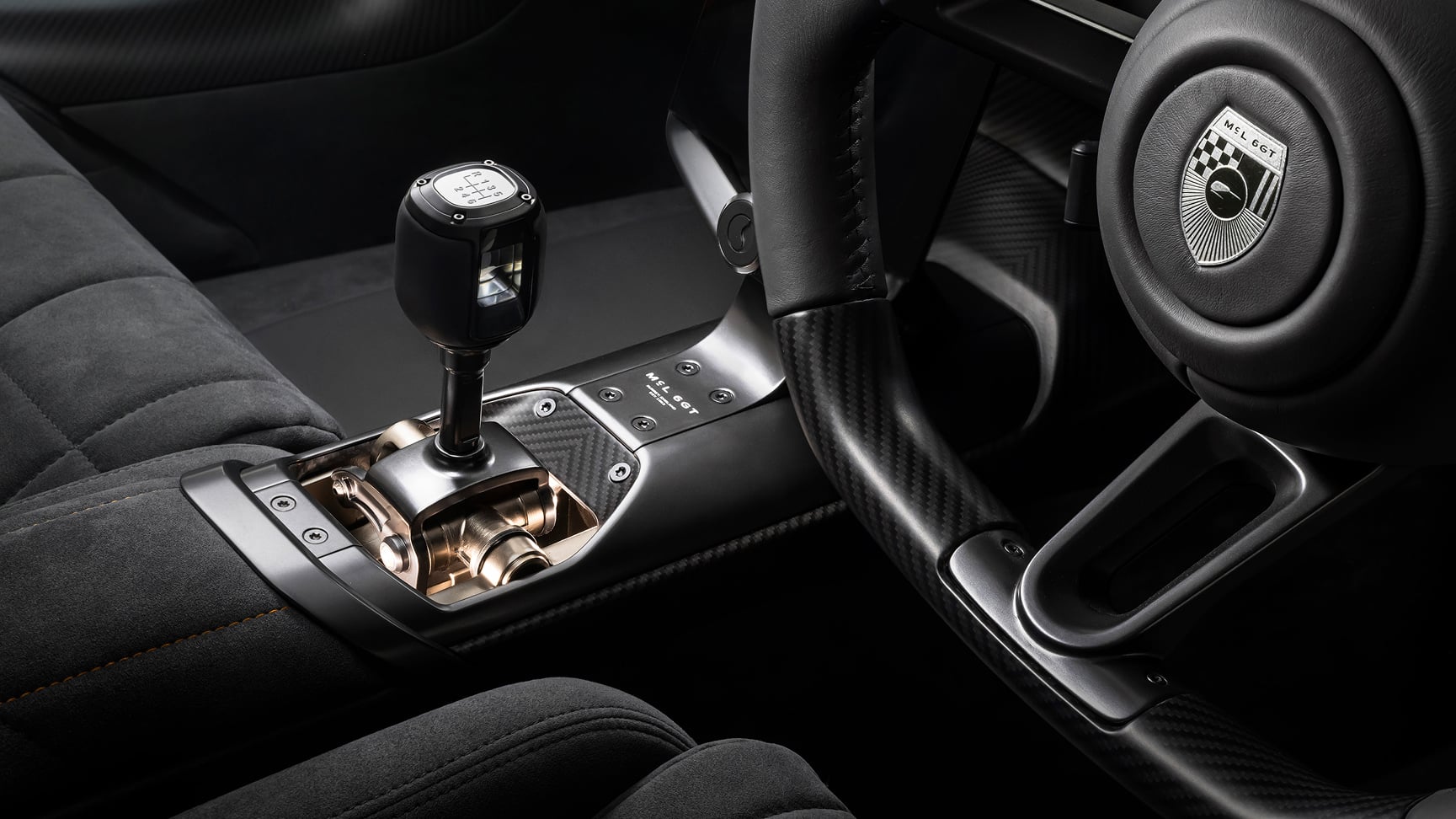
This detail captures an important idea behind the McL 6GT: emotional appeal can emerge from the way something works. A control becomes memorable through its movement, its shape, and the attention it asks of the person using it.
A Cockpit Designed Around Touch
A manual gearbox can only tell part of the story. The surrounding controls need to support the same sense of connection.
Hydraulic steering, tactile switchgear, and visible engineering details carry that thinking throughout the McL 6GT. Knurled, machined aluminium controls bring texture to the surfaces the driver uses, while carefully considered ergonomics give those interactions a clear place within the cockpit.
There’s a practical logic to this approach. The driving environment is experienced through hands and fingertips as well as through sight. The shape of a control and the way it sits within reach can be as important to its character as its appearance.
This interpretation of tactility also leaves room for contemporary technology. Digital instrumentation forms part of the concept, retaining the clarity and emotional appeal of the original car’s instruments. Boxed quilting is similarly reinterpreted for a modern interior.
Together, these choices allow heritage to influence how the cabin feels without fixing it in the past. The aim is a coherent environment in which materials, controls, and information all serve the driver.
The M6GT’s Influence Runs Deeper Than the Silhouette

Viewed from the outside, the McL 6GT sits exceptionally low and wide. Its low nose recalls the stance of the M6A racer that underpinned the M6GT, establishing a visible connection with the concept’s origins.
Clean body surfaces extend towards a distinctive Kammback tail. The roof flows into the rear deck and engine cover, making the cabin appear embedded within the body. That continuity gives the car a unified form, with each section contributing to the whole.
The historical references continue in the smaller details. A “Racing loop” motif, inspired by the M6GT’s original rear lights, is integrated into the exterior airflow architecture. An element remembered for its appearance becomes part of a contemporary design with an aerodynamic role.
The panel that once covered the M6GT’s fuel tank has also been reimagined. In the concept, it becomes a distinctive feature celebrating exposed metal craftsmanship.
These details show how heritage can be developed rather than simply repeated. Each reference has an opportunity to contribute something useful to the new car’s identity.
Carbon Fibre, Exposed Metal, and a Meaningful Red
At the centre of the McL 6GT is a carbon-fibre monocoque. It forms the foundation of the concept’s lightweight construction, with the material’s layered structure deliberately revealed throughout the design.
Showing that construction gives the engineering a visible presence. The materials become part of the story the car tells, allowing its structure and craftsmanship to contribute to its appearance.
The exterior colour takes a similarly considered approach. Inspired by the red of Bruce McLaren’s own M6GT, it combines modern paint technology, a high-metallic finish, and red pigments to create a rich depth of colour.
It’s a contemporary treatment with a specific historical connection. Alongside exposed metal and carbon fibre, it gives the concept a material character that extends beyond its outline.
Other references reward a closer look. Bruce’s original M6GT number plate is reinterpreted as a tone-on-tone graphic, his signature appears in the engine bay, and the Speedy Kiwi is discreetly etched into the fuel filler cap.
The McLaren Shield also receives a contemporary interpretation, honouring the emblem Bruce placed on his racing cars. These touches make the heritage personal, linking the concept to the individual whose ambition helped set the direction.
What the McL 6GT Says About Our Future
The McL 6GT is a concept, and its significance should be understood in that context. It expresses a direction for the brand’s thinking and lays the foundations for a newly positioned, highly exclusive type of McLaren supercar beyond their core and expanded portfolio.
The most interesting possibility is the way it brings its ideas together. Lightweight carbon-fibre construction supports a purposeful mechanical layout. A manual gearbox makes participation central to the experience. Heritage informs the shape, materials, and controls, while digital instrumentation brings a contemporary element to the cabin.
That combination gives the concept a clear editorial story: progress can include a more deliberate relationship between the person driving and the machine responding.
Bruce McLaren’s original supercar ambition still has the power to provoke fresh ideas. With the McL 6GT, McLaren’s exploring where that ambition can lead when the experience at the wheel becomes the starting point. The gearstick is the most obvious invitation. The rest of the car is designed to continue the conversation.


0 Comments